

When addressing pressure management in modern plumbing systems, especially in large-scale and high-rise buildings, Pressure Reducing Valves (PRVs) play a critical role. These devices are essential for maintaining consistent pressure levels throughout the water distribution system, ensuring safety, comfort, and system integrity. However, improper sizing and lack of system considerations can lead to unintended consequences, such as excessive noise, wear, and even failure. In this technical paper, Dave Rhodes, Technical Manager at Albion Valves (UK) Limited, will delve into the importance of correct PRV sizing, particularly in high-rise applications, the correlation between valve size and operational noise, and how design innovations and complementary components, like strainers, contribute to better performance and system longevity.
The Complexity of PRV Sizing: High-Rise Buildings vs. Smaller Installations
One of the most significant challenges in designing pressure management systems is properly sizing PRVs according to the building type and water demand characteristics. In smaller installations, such as single-family homes, the flow rates are relatively predictable and consistent. The variation between low and high demand periods is minimal, making PRV selection more straightforward.
In contrast, high-rise buildings present a much more complex scenario. These buildings often include multiple apartments or commercial units that are all fed by a shared supply line. The aggregate demand from these units can fluctuate significantly throughout the day. During peak usage hours, such as mornings or evenings when many occupants are using water simultaneously, the flow rates are much higher. Conversely, during off-peak hours, the demand may drop substantially.
This variation in flow, often expressed in terms of loading units or flow diversity, introduces complications in valve sizing. A PRV in a high-rise building must be able to regulate pressure accurately and reliably under both low and high flow conditions. This dual capability becomes more difficult to achieve with larger PRVs, which are typically installed to accommodate high maximum flows.
Noise Issues Arising from Oversized PRVs
When a PRV is too large for the application or is not optimised for low-flow performance, a range of issues can occur, most notably, noise. In low-flow conditions, an oversized valve may only need to make a small stroke to regulate the pressure. This minimal movement means that water passes through a very narrow gap at high velocity, often striking the valve seat or internal surfaces. This high-velocity flow can create turbulence and vibrations, which manifest as audible noise.
These noises can be particularly disturbing in residential buildings where mechanical systems are located close to living spaces. In addition to being a nuisance, noise is often a sign of inefficiency and can be an early warning of accelerated wear or valve failure.
A further effect of oversized PRVs is that these can also lead to pressure fluctuations, particularly under low flow conditions, because the valve may struggle to maintain stable control when operating far below its optimal flow range. This instability can cause hunting or oscillations in downstream pressure. To address this, some installations with larger flanged PRVs incorporate a bypass valve. The bypass valve handles low flow situations with greater precision, while the main PRV remains closed until higher demand occurs, ensuring steadier pressure control across all operating conditions.
This is where intelligent valve design becomes critical. While noise may appear to be a superficial comfort issue, it often points to more serious underlying problems in system performance and sizing compatibility. Engineers should take this seriously when planning for pressure regulation in large buildings.
Design Solutions: PRVs Engineered for Quiet Operation
To address the challenges mentioned above, several manufacturers have developed PRVs with advanced internal geometries and flow control mechanisms that significantly reduce noise, even under varying flow conditions.
For instance, Albion’s ART 678 and ART 679 ranges of PRVs are notable examples of such innovation. These valves are engineered to perform efficiently across a wide range of flow rates, incorporating a design that minimises pressure fluctuations and reduces the likelihood of high-velocity water streams in low-demand conditions. Special features such as optimised valve seat shapes, improved diaphragm control, and multi-stage pressure reduction mechanisms contribute to smoother operation and quieter performance.
A real-world example of these advancements can be seen in the recent installation of a DN50 PRV from this product family in a London high-rise building. The valve was selected not just for its capacity, but also for its low-noise performance. Despite being a relatively large diameter valve, its design ensures silent operation during both peak and minimal flow periods, offering a significant improvement in occupant comfort and system reliability.
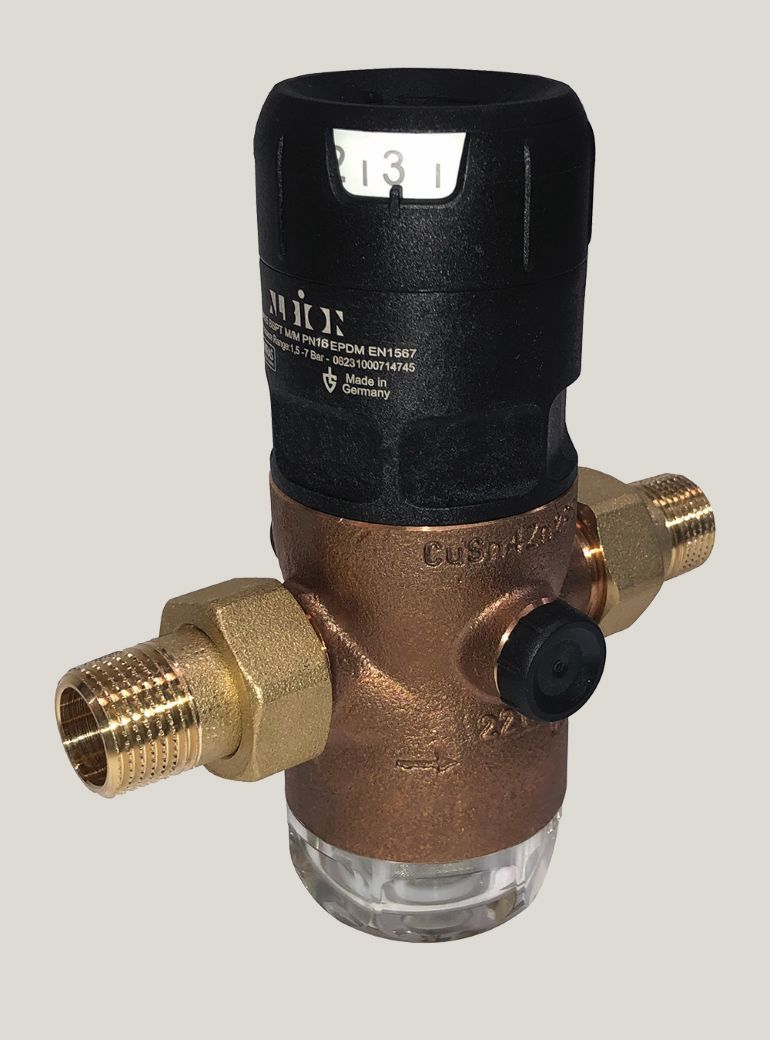
Image Caption: The Albion ART 678 ranges of PRVs engineered with advanced internal geometries to ensure quiet and reliable performance even during low-flow periods.
The Often Overlooked Importance of Strainers
While selecting the right PRV is essential, the supporting components in the pressure regulation system are equally important. One such component is the strainer, a simple device that filters out debris, sediment, and particulate matter from the water before it enters the PRV, making it a vital part of the system.
Inadequate filtration can lead to particle accumulation on the valve seat or diaphragm of the PRV, which not only causes inconsistent pressure regulation but may also accelerate corrosion, wear, and eventual failure of the valve. These issues are especially prevalent in older buildings or systems where water quality may fluctuate, or in areas with high mineral content or rust-prone piping.
Installing a properly sized and maintained strainer upstream of the PRV helps ensure that the valve operates as intended over its full service life. It also protects downstream fixtures and appliances, contributing to the overall health and efficiency of the plumbing system.
In summary, the pairing of a well-designed PRV with a high-quality strainer should be considered best practice in all professional plumbing installations, particularly in complex systems like high-rises or mixed-use buildings.
Lead-Free Materials and the Push for Safer Drinking Water Installations
Beyond performance and reliability, there is growing attention surrounding the material composition of valves and fittings in drinking water systems. In Europe and many other parts of the world, regulatory updates have placed increasing emphasis on reducing or eliminating lead from plumbing materials. Lead, once a common component in brass alloys, has been shown to leach into drinking water under certain conditions, posing health risks, particularly to vulnerable populations such as children and pregnant women.
The European Drinking Water Directive (DWD), which was recently updated, now sets stricter requirements for materials in contact with potable water. This includes a push toward lead-free materials in valves, fittings, and other plumbing components. Many manufacturers are responding to this by redesigning their products using alternative alloys, such as lead-free brass or stainless steel, and undergoing rigorous testing to meet compliance standards.
For engineers, architects, and building owners, this regulatory evolution is both a challenge and an opportunity. By specifying lead-free PRVs and accessories, they not only future-proof their installations against upcoming legal requirements but also promote healthier and safer water systems for occupants. As sustainability and environmental health gain priority in the construction industry, materials transparency and regulatory alignment will continue to be a deciding factor in product selection.
Conclusion: Holistic Planning for Pressure Management Systems
Efficient and safe water distribution in buildings relies heavily on well-designed pressure management systems. Selecting and properly sizing PRVs is a key part of this, particularly in high-rise and large-scale applications where flow variation is substantial. Incorrect sizing can lead to operational issues such as noise and wear, while the right valve, designed with noise-reducing features, can ensure quiet, consistent performance.
However, the valve alone is not enough. Incorporating other components such as strainers, and selecting products made from lead-free materials, are equally important for achieving long-term performance, compliance, and safety.
As building technologies and regulatory landscapes evolve, so too must our approach to system design. With advanced PRVs like Albion’s ART 678 / ART 679 and strainers like the ART 369, and with increased attention to materials and system protection, engineers can build plumbing systems that meet the demands of modern architecture—quietly, safely, and sustainably.
This article was featured in the Spring '26 edition of BIMCRUNCH. Find the full magazine here. To learn more about Albion Valves or download their BIM objects, join Bimstore for free. For additional information, visit the Albion Valves manufacturer profile or their company website and social media pages.


Magazine
BIMCRUNCH Spring '26 is here: read our new edition today!
This Spring Edition of BIMCRUNCH celebrates a new way of thinking across the built environment, reflecting trends in material innovation, building safety compliance, and low-carbon heating systems. This edition features insights from leading UK and Australian manufacturers, alongside feature articles on digital workflows and smart modelling. We also close the first quarter with the exciting news that Bimstore's parent company has been recertified as a B Corp organisation.